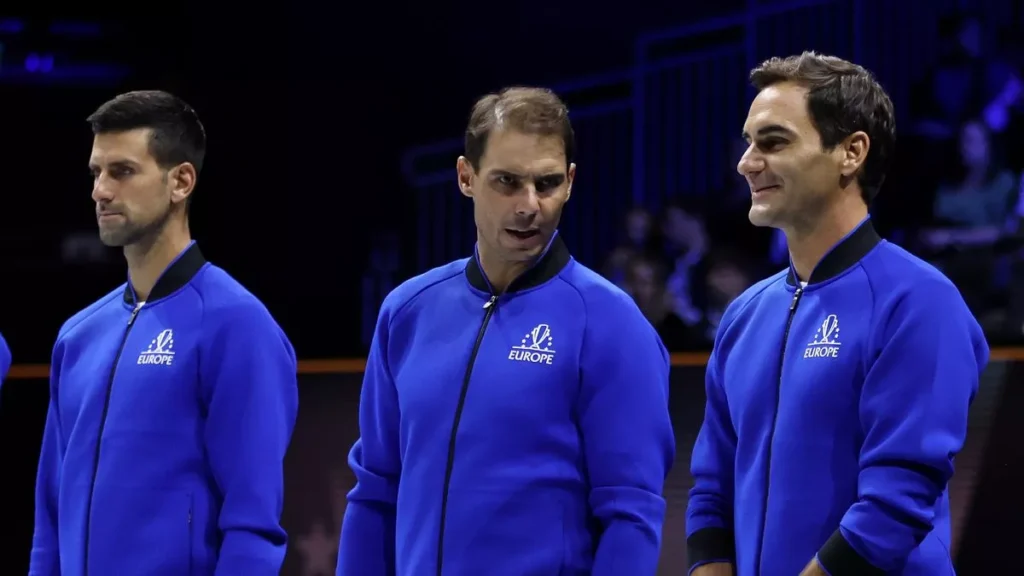
Facing a future legend before they become legendary is a rare experience. Many top-ranked players today once shared the court with Roger Federer, Rafael Nadal, and Novak Djokovic when they were just teenagers, still finding their way in the professional ranks.
While most players who competed against them early on could see their immense talent, not everyone was convinced that all three would go on to dominate tennis for two decades. In a recent revelation, a former ATP player admitted that, after playing all three in their youth, he doubted one of them had what it took to become an all-time great.
Looking back, that judgment turned out to be very wrong, as all three became the undisputed Big Three, winning a combined 66 Grand Slam titles. But at the time, one of them didn’t stand out as a future world-beater.
So, who was the player that sparked doubt? And why did he seem like the least likely to become a tennis legend? Let’s take a deep dive into this fascinating early assessment of the sport’s greatest champions.
Facing the Big Three as Teenagers
Every tennis legend starts somewhere, and Federer, Nadal, and Djokovic were no different. Before they became household names, they were young prospects, grinding their way through early ATP tournaments and trying to prove themselves against established professionals.
One former pro who faced all three as teenagers recently shared his perspective:
“I played them all when they were still coming up. Federer had ridiculous talent, Nadal had insane intensity, but I wasn’t convinced Djokovic had what it took.”
To hear doubts about Novak Djokovic, now the most successful male Grand Slam champion in history, seems shocking. But in his early years, there were genuine concerns about whether he had the physical and mental attributes to compete at the highest level.
Why Djokovic Wasn’t Seen as a Future Legend
1. Physical Fragility and Stamina Issues
Unlike Nadal, who was a physical beast from day one, and Federer, who moved effortlessly, Djokovic’s early years were marked by fitness struggles.
- He often retired mid-match due to breathing difficulties.
- His stamina was questionable in long matches, leading some to doubt if he could survive five-set battles.
- He lacked the physical presence of Nadal or the smooth grace of Federer.
At the time, some saw him as talented but fragile, raising concerns about his ability to last on tour.
2. Mental Toughness Concerns
Djokovic is now known as one of the most mentally strong athletes in sports history, but that wasn’t always the case. Early in his career, he showed signs of frustration and inconsistency.
- He had moments where he lost focus in big matches.
- He was more vocal and emotional than Nadal and Federer, leading some to believe he lacked their composure.
- Opponents noticed that, unlike Nadal, who never mentally cracked, Djokovic sometimes got rattled when things weren’t going his way.
One player who faced Djokovic in his early years said:
“I remember thinking, ‘He’s good, but does he have the mental game to go all the way?’”
3. Playing Style Wasn’t Fully Developed
Unlike Nadal, who had his trademark topspin-heavy game, or Federer, who was an offensive maestro, Djokovic was still developing his identity as a player.
- His defense was solid but not extraordinary at the time.
- His return of serve, which would later become his greatest weapon, was good but not elite.
- His forehand lacked the punch of Federer’s or Nadal’s at a young age.
Because of this, some players didn’t see anything truly special about him early on. He was good—but great? They weren’t sure.
How Djokovic Proved Everyone Wrong
Despite these early doubts, Djokovic transformed himself into one of the greatest players ever. His rise was fueled by relentless work ethic, strategic improvements, and an unbreakable mindset.
1. Physical Transformation
Djokovic recognized his fitness issues and made drastic changes:
- Adopted a gluten-free diet, solving his breathing problems.
- Focused on flexibility and endurance, making him one of the most durable athletes in sports.
- Developed legendary movement, turning his defense into an impenetrable wall.
2. Mental Growth
Djokovic’s biggest evolution was in his mentality. He went from a volatile young player to a man who thrives under extreme pressure.
- His 2019 Wimbledon final victory over Federer, saving championship points, showcased his mental dominance.
- He turned crowd negativity into motivation, proving he could win even when stadiums cheered against him.
- He learned how to stay composed and problem-solve, a crucial difference between good players and legends.
3. Mastering His Playing Style
Djokovic refined every part of his game, making him the most complete player of his era.
- His return of serve became the greatest in tennis history.
- His defensive skills turned him into an unbreakable force.
- His serve, once a weakness, became a weapon in crucial moments.
By the time he won his first Grand Slam at the 2008 Australian Open, he had already silenced many doubters. But by 2011, when he went on a 43-match winning streak, there was no question—Djokovic was an all-time great.
How Federer and Nadal Were Seen as Teens
Unlike Djokovic, Federer and Nadal were seen as destined for greatness from a young age.
Federer: The Effortless Prodigy
- Federer’s talent was obvious early on.
- Even as a teenager, he had natural grace and attacking instincts.
- After beating Sampras at Wimbledon in 2001, the world knew he was special.
Nadal: The Warrior from Day One
- Nadal’s intensity was unmatched—even in practice.
- His mental strength was legendary before he won his first Slam.
- He beat Federer at 17 years old in 2004, proving he was ready for the biggest stage.
Nadal and Federer were seen as sure-fire champions early, but Djokovic had to fight to change the perception that he wasn’t at their level.
Final Thoughts: The Player Who Beat the Odds
It’s incredible to think that Novak Djokovic, the player once doubted by peers, has now:
- Won the most Grand Slams in men’s history.
- Achieved the longest reign as world No. 1.
- Beaten both Federer and Nadal in head-to-head matchups.
The player who some thought wouldn’t make it ended up surpassing both his rivals statistically.
This story is a reminder that first impressions in sports aren’t always right. Some champions are born, others are made—and Djokovic is the ultimate example of a player who made himself into a legend.
Leave a Reply